Carrying Firmware in a Backpack: Update Delivery for Devices That Never See a Network
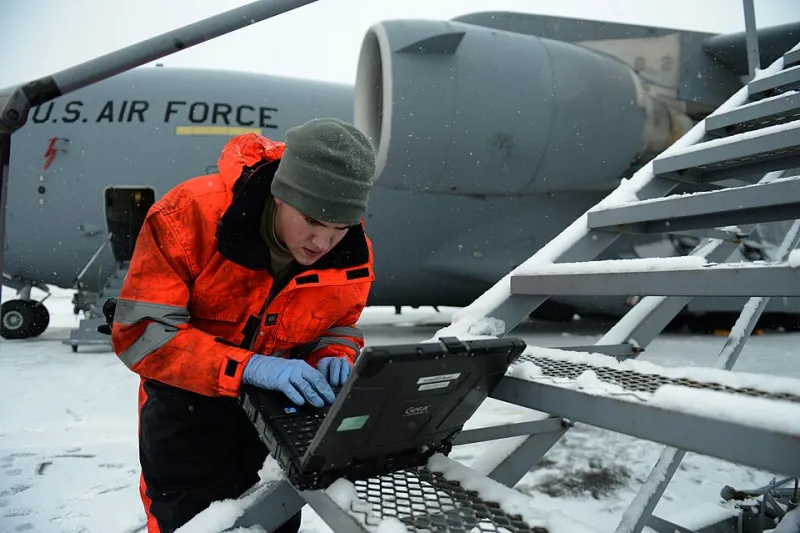
Photo: Airman 1st Class Gustavo Castill, Public domain, via Wikimedia Commons
The OTA literature has a blind spot: it assumes the 'air' exists. Yet a meaningful slice of the American device fleet — warehouse scanners in rural distribution centers, agricultural controllers across the Great Plains, utility meters in mountain valleys, forklift telemetry units inside steel-clad buildings — never establishes an internet connection at all. For these devices, 'over-the-air' is aspirational. The update travels by truck.
That doesn't mean the update pipeline has to travel by truck too. The same engineering discipline that governs a cloud-delivered rollout can govern a sneakernet one, provided you design for it deliberately rather than bolting it on after the first bad flash.
The Staging Layer Is Your New CDN
Think of a field technician's laptop as an edge cache with legs. The pattern most mature industrial teams converge on looks like this:
- A staging service in the corporate environment receives signed firmware bundles from the same build pipeline used for connected devices.
- A technician client synchronizes with that service, downloading only the bundles relevant to the sites and device models on the day's route.
- The field device pulls from the laptop over USB, serial, or a local Bluetooth Low Energy link — anything short-range and physically proximate.
The critical design decision is that the technician client never authors updates. It fetches, verifies, and relays. If your field tooling can modify a bundle, you've turned every laptop into a signing oracle.
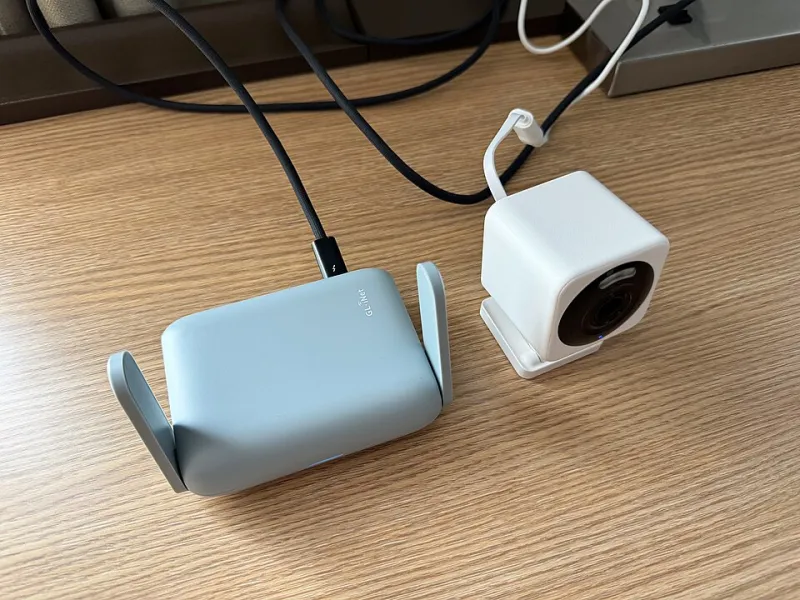
Some fleets skip the laptop entirely. A BLE gateway — a small battery-powered puck that pairs with a phone app — can bridge from a technician's pocket to a sealed enclosure. This is increasingly common in cold-chain monitoring and vending, where opening a panel door is itself an operational cost.
Verification Without a Network
A device that can't reach the internet can't check a CRL or fetch a timestamp token. So the trust model has to collapse onto whatever arrives in the technician's hands, and that means:
- Signatures verified entirely on-device, with the public key burned in at manufacture. No intermediate fetches, no 'check the server later.'
- Anti-rollback counters stored in tamper-resistant storage, so a technician carrying an old bundle can't accidentally regress a device past a security patch.
- Bundle manifests that bind firmware to device model, hardware revision, and region — the on-device equivalent of a canary cohort check.
The USB stick deserves specific attention. Consumer flash drives fail at rates that surprise people who've never audited them, and they pick up filesystem corruption from temperature swings in a truck bed. Best practice is to treat removable media as untrusted transport: the device verifies the signature, not the stick. Some teams go further and require the drive itself to be a managed, hardware-token device rather than whatever was on sale at the office supply store.
The Audit Trail Problem
Here's where offline OTA gets genuinely hard. When an update ships over the network, you get delivery logs, ACKs, and telemetry for free. When it ships in a backpack, your audit trail is whatever you designed before the technician left the building.
The minimum viable record set:
- At staging time: which bundle, which technician, which route, what hash.
- At flash time: device serial, previous firmware version, new version, timestamp from the device's own clock, and the result code.
- At next connectivity — which might be weeks later — the device or the technician's client uploads the flash-time record.
That last step is the one teams forget. A device that never touches the internet still needs to eventually report what happened to it, even if the report arrives via the technician's client syncing over hotel Wi-Fi. Without it, your fleet inventory is a guess, and your compliance story for customers in regulated industries — food safety, utilities, medical adjacent — falls apart under the first serious audit.
Rollout Discipline Still Applies
The temptation with offline updates is to treat them as monolithic: the whole site gets v2.4.1 because the technician is already there. Resist it. The staged-rollout logic that protects a connected fleet belongs in the staging service too. Route planning can encode canary rules: flash two units at the Pittsburgh site, hold until the next visit, then proceed. It's slower than a server-side percentage rollout, but the blast radius of a bad offline image — where recovery may require a second truck roll — is far larger.
Some operations formalize this with a dedicated 'update cart': a ruggedized case containing a tablet, battery pack, cable kit, and pre-authorized bundles for the day. It sounds quaint until you compare its failure modes against emailing firmware to whoever happens to be on site.
Design for the Truck, Not the Data Center
Offline OTA isn't a corner case; it's a parallel architecture with the same requirements — integrity, staged rollout, rollback, audit — satisfied under different physics. Teams that succeed treat the field technician's kit as infrastructure: versioned, monitored, and subject to the same release discipline as any server. Teams that fail treat it as an errand.
The devices in the dead zones still deserve a pipeline. Build one that fits in a backpack.