Rush Hour Doesn't Apply to Firmware: Timing OTA Rollouts Around Device Rhythms
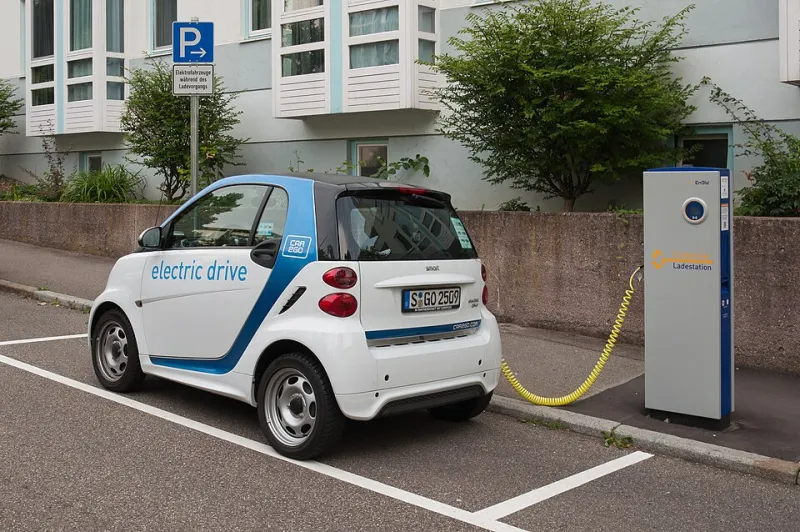
Photo: Julian Herzog (Website), CC BY 4.0, via Wikimedia Commons
Every fleet has a rhythm. Electric vehicles plug in when their owners get home from work. Retail barcode scanners return to their docks when the store closes. Smart speakers sit nearly idle from midnight until the first alarm goes off. These rhythms are as predictable as anything in distributed systems gets — and yet plenty of OTA pipelines ignore them entirely, treating a fleet of ten million devices as ten million always-on, always-ready endpoints.
They are not. A device that's asleep, on cellular, mid-transaction, or critically low on battery is a device that will defer, fail, or worse, accept an update at the worst possible moment. Timing isn't a nicety in OTA scheduling. It's one of the highest-leverage variables you control.
Why the Default Window Fails
The naive approach — push to everyone at a fixed UTC time — fails for reasons that vary by fleet. For a consumer product with a US-wide footprint, a 2 a.m. Eastern push lands at 11 p.m. Pacific, when plenty of users are still awake and using the product. For a fleet of point-of-sale terminals, any daytime window collides with revenue-critical operation. For EVs, a midday push reaches vehicles that are, by definition, driving.
The failure modes compound. Updates deferred by busy devices pile up and hit your infrastructure in a thundering herd the moment the fleet wakes. Updates applied at bad moments generate the support tickets that end up in postmortems.
Device State Is the Real Scheduler
The most reliable update window isn't a time of day. It's a state. Define, per product, the conditions under which a device is a good update candidate:
- Docked and charging, for tools, scanners, and handhelds — the device is stationary, powered, and off-shift.
- Connected to the charger and past a state-of-charge threshold, for battery devices — typically 50% or higher, so a failed update can't strand the device.
- Idle for N minutes, for interactive products — no active session, no user input, no media playing.
- On a trusted network, for anything handling sensitive data — home Wi-Fi rather than cellular, corporate LAN rather than public AP.
Then let the device, not the server, decide when those conditions are met. The server declares eligibility; the device declares readiness. This inversion is the single most important architectural decision in scheduled rollouts, because the device has ground truth on its own state and the server does not.
Working With Time Zones Instead of Against Them
For consumer fleets spanning the continental US, four time zones mean any fixed schedule is a rolling wave whether you intend it or not. Make the wave deliberate.
Express update windows in the device's local time rather than the server's. A rule like "eligible between 2:00 and 5:00 a.m. local, only when idle and on AC power" produces a clean sweep across the country, keeps your infrastructure load spread over three hours instead of spiking in one, and guarantees no user in any zone gets a reboot mid-evening.
One caveat: local time depends on the device knowing its local time. Devices without a real-time clock or an NTP source can misreport time zone — a meaningful failure mode in rural coverage areas. Where local time is uncertain, fall back to coarse server-side scheduling with wider windows, and treat the precision of your window as bounded by the precision of your device's clock.
Prediction Beats Reaction
Once you've shipped a few campaigns, your own telemetry becomes a forecasting asset. Historical check-in data tells you when each cohort of devices actually comes online, how long update-and-reboot cycles take per hardware revision, and what fraction of a cohort defers past its first window.
Use this to model rollout timelines honestly. If 30% of a cohort historically defers an update by 24 hours, schedule your campaign to complete in three days, not three hours, and set stakeholder expectations accordingly. For EV fleets, charging sessions themselves are the signal — pairing with utility time-of-use rates, many owners charge on predictable schedules that your update windows can align with almost perfectly.
Prediction also improves the user experience side. A product that says "we'll update overnight while you're charging" behaves like a well-maintained appliance. A product that reboots during a 9 a.m. meeting behaves like a liability.
Scheduling as a First-Class Release Parameter
Treat the update window as part of the release artifact, versioned and reviewed like the firmware itself. A campaign definition should specify: eligibility conditions, the local-time window, deferral policy (how many times a device may postpone, and what happens after), and the safety interlocks — minimum battery, required network type, prohibition of updates during detected active use.
Rollout mechanics layer on top: start with a small cohort in one time zone, verify success rates and post-update telemetry, then widen the wave east to west or west to east as confidence builds. The time zones become a natural staging environment — by the time the campaign reaches the last zone, you've effectively run the release four times.
Fleets live in the real world, and the real world keeps a schedule. Firmware that respects it ships quietly. Firmware that doesn't ships headlines.